


ChatGPT for lawyers is no longer hype — generative AI is actively reshaping the legal industry. In 2024, 79% of legal professionals reported using AI in their practices, a 60% increase from the previous year. This rapid growth signals that tools like ChatGPT have moved beyond experimentation and into mainstream adoption, streamlining workflows and boosting efficiency across firms of all sizes.
But AI adoption also raises serious concerns around data privacy, ethical compliance, and misinformation. Most general-purpose tools, including ChatGPT, store user prompts unless you opt out, and outputs can include hallucinated or fabricated legal content. Without clear policies or safeguards, even well-meaning use can result in ethical violations.
There have already been several publicized cases, such as Mata v. Avianca, Inc., and widespread use of AI hallucinations, where lawyers faced sanctions for citing made-up case law generated by AI, underscoring the importance of human oversight.
In this post, we’ll explore five practical use cases of ChatGPT for lawyers, highlight key guardrails to follow, and show how you can put AI to work responsibly.
Why Law Firms Are Exploring ChatGPT Now
Law firms of all sizes are under increasing pressure to operate more efficiently, especially solo practitioners and small teams juggling high caseloads with limited support.
At the same time, client expectations have shifted. They want faster responses, clearer communication, and more transparency at every stage. Firms that don’t embrace the benefits of AI risk falling behind. Putting that in context, a report by Goldman Sachs found that 44% of legal work could be automated.
Given that many firms bill by the hour, clients are starting to demand greater efficiency. Up to 70% of clients remain agnostic or actively prefer their law firm to use AI to reduce the time on administrative tasks.
How ChatGPT allows lawyers to expand their client base
It is estimated that only 50% of the American population has worked with a lawyer. The other half avoids lawyers for two reasons:
- They don’t understand how a lawyer can be helpful to their situation (and cannot find answers to their questions online).
- They perceive legal services as being too expensive (which they often are when billed by the hour).
Let’s also consider that younger generations represent the bulk of tomorrow’s clients, and younger clients prefer law firms that use AI. A report from Clio shows that millennials and Gen Z are more likely to hire a lawyer who uses legal technology.
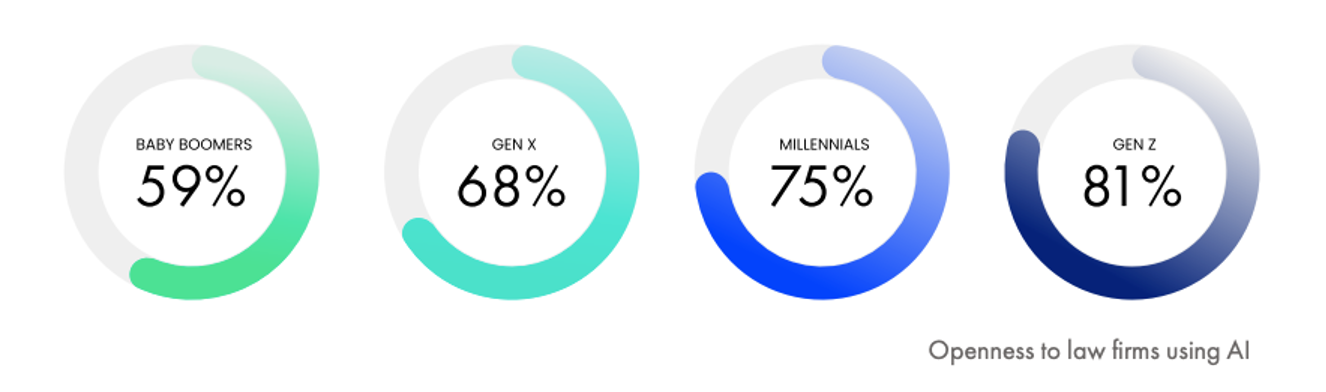
Firms that use AI to make their services more efficient and affordable can reach a wider pool of potential clients, including people who previously avoided legal help due to cost or complexity.
They are also better positioned to meet the expectations of younger clients who prefer working with tech-enabled law firms.
Tools like ChatGPT make this possible. It’s low-cost, easy to use, and doesn’t require technical skills or complex setup, making it a smart choice for busy lawyers looking for quick wins.
Here’s how you can safely integrate its capabilities in your firm and win more clients by leveraging AI.
5 Risk-Reduced Ways Law Firms Are Using ChatGPT Today
Not all AI use cases are created equal, especially in a field as sensitive and regulated as law.
But that doesn’t mean firms need to sit on the sidelines. When used carefully, ChatGPT can streamline routine tasks without exposing the firm to compliance issues or data risks.
The key is knowing where the line is. Below are five practical, low-risk ways legal professionals are using ChatGPT today to boost productivity, reduce overhead, and focus more energy on high-impact legal work.
Drafting routine client communications
Lawyers spend a surprising amount of time sending variations of the same messages, like appointment reminders, follow-up emails, intake confirmations, and status updates.
While these communications are essential for maintaining strong client relationships, they rarely require deep legal insight.
ChatGPT can help by generating polished, professional message templates in seconds. You can prompt it to match your firm’s tone (whether it’s formal, friendly, or somewhere in between) and adapt templates for different practice areas or scenarios. This is especially useful for junior staff or solo practitioners looking to save time without compromising on client service.
Because no confidential case information is shared during this process, it’s a low-risk way to introduce generative AI into your firm’s daily workflow.
Just remember to review and customize each message before sending to ensure it meets your standards.
Summarizing public case law and regulations
Legal research is time-consuming, even when the materials are public. ChatGPT can help lawyers quickly digest lengthy case law, judicial opinions, or regulatory updates by generating plain-language summaries or extracting key points.
For example, after pasting a publicly available ruling into ChatGPT, you can ask it to explain the decision in bullet points, outline the implications, or compare it to a previous case.
This makes it easier to stay on top of changes in your practice area without falling behind on client work.
Because this workflow relies only on public documents and doesn’t involve client data, it avoids the privacy concerns that often come with AI.
It’s also a great starting point for internal briefings, newsletter content, or discussions with non-legal stakeholders who need a quick, clear summary of what’s changed.
Creating client-facing FAQs
The legal market is full of unmet expectations, and clients are noticing.
According to a legal trends report from Clio, 67% of law firms fail to respond to potential clients via email, and when they do, most responses don’t answer the questions people actually care about. Even worse, 48% of firms don’t answer the phone or return calls, making them practically unreachable.
That lack of responsiveness contributes to a poor client experience and creates a lasting negative impression across the board.
And while 74% of lawyers say they optimize their websites to promote their services, potential clients often can’t find answers to basic, high-intent questions, like whether a firm has experience with similar cases, what the hiring process looks like, or how much services might cost.
That’s where ChatGPT can help.
Law firms can use AI to draft clear, helpful answers to real questions they receive from prospects, turning those answers into FAQ pages, blog posts, or intake handouts.
This content helps demystify the legal process and builds trust before a single consultation. Unlike chatbots that try (and often fail) to replace human interaction, well-written FAQ content offers transparency on the client’s terms, day or night, no phone call required.
Because the content is general and reviewed before publishing, it poses little risk, yet makes a significant impact on transparency, credibility, and client confidence.
Building first drafts of marketing content
Many lawyers know they should be publishing more (whether that’s blog posts, newsletters, or social media content), but few have the time.
Marketing tends to fall to the bottom of the priority list, especially when billable work piles up. But, this is a great, safe, and ethical use of ChatGPT for lawyers.
Many law firms are using it to quickly generate first drafts of marketing materials.
For example, you might prompt it to:
- Outline a blog post on a key topic your potential clients care about
- Write LinkedIn copy for a new service launch
- Summarize a recent legislative change for your email list
- Brainstorm titles, captions, and calls to action tailored to your practice area.
ChatGPT makes it easier for busy lawyers and their marketing teams to maintain a consistent online presence by handling the heavy lifting of ideation and initial drafting. And because a human edits the content before publishing, you retain full control over tone, accuracy, and compliance.
If you’re looking for an even more tailored approach, FirmPilot’s legal-specific AI models are tailored to your marketing needs.
This proprietary technology allows you to generate marketing content optimized for your firm’s SEO needs that is not only compliant with industry standards but also designed to convert website visitors into clients.
Structuring document templates and checklists
From intake forms to engagement letters and due diligence checklists, legal work involves a wide range of standard documents that get reused across cases.
But creating or updating these templates from scratch can eat up hours, especially for solo or small firm lawyers without admin support.
ChatGPT can help jumpstart this process. You can ask it to generate initial drafts of repeatable, non-confidential materials like:
- Client intake questionnaires
- Appointment confirmation templates
- Standard engagement letters
- Internal checklists (e.g., for discovery or court filings)
Because these documents don’t contain sensitive or client-specific information, using ChatGPT to draft or refine them is considered low-risk.
However, lawyers must always check the terms of service of any AI platform they use to understand how their data is stored and who has access to it.
For instance, some AI companies retain the inputs and data supplied, while others use these to train their AI models. Some companies own the copyright to the outputs while others enable unrestricted use, even for commercial purposes.
The fine print matters.
Know the Limits: ChatGPT Guardrails Every Lawyer Should Follow
As powerful as tools like ChatGPT are, they come with real risks, especially when applied to legal work.
Law firms must approach AI adoption with caution, ensuring that usage remains compliant with ethical obligations, data privacy laws, and jurisdictional requirements.
Here are the key guardrails every lawyer should consider:
1. Know where your data goes and who can see it
Before using any AI system, lawyers should thoroughly review the terms of service to understand:
- How data is stored and secured
- Whether prompts and outputs are retained or reused
- If submissions are used to train future models
- Who owns or can access the submitted information
Most free or consumer-grade versions of ChatGPT do not offer confidentiality guarantees, which makes them unsuitable for any use involving sensitive or privileged information.
However, you may wish to use a purpose-built AI legal technology or negotiate a custom enterprise agreement with OpenAI for more sensitive use cases (like summarizing evidence, extracting key facts from documents, drafting case documents, or organizing a client’s ZIP file of scanned materials).
2. Don’t share confidential or privileged information by default
For firms using a regular ChatGPT license, it’s essential to avoid entering any case-sensitive or privileged information. That includes client names, legal documents, and case details.
Most firms won’t pursue an enterprise license with custom terms, so it’s best to limit use to low-risk tasks like summarizing public content, drafting client-facing communications, or creating marketing materials.
If you’re exploring more advanced applications, consider purpose-built legal AI tools. These are better suited for tasks such as:
- Creating timelines from chronological case documents
- Summarizing lengthy depositions or client records
- Organizing mixed-format materials for litigation prep
3. Always verify the output to avoid hallucinations
One of the most common risks with using ChatGPT in legal workflows is hallucination, the model’s tendency to generate information that sounds plausible but is factually incorrect.
This includes making up case law, misquoting statutes, or oversimplifying legal concepts. While the output may read fluently, it can introduce subtle errors that go unnoticed unless carefully reviewed.
That’s why it’s critical to treat every AI-generated result as a first draft, not a finished product.
Lawyers should never rely on ChatGPT to provide legal advice, cite authorities, or compare legal strategies without doing due diligence. Instead, use it to support lower-risk drafting and ideation tasks, then verify accuracy before use.
To stay on the safe side, here are some outputs that should always be reviewed before being used in client work or marketing materials:
- Summaries of legal documents or depositions
- Drafted FAQ or educational website content
- Suggested contract clauses or templates
- Explanations of legal procedures in plain English
Human review isn’t just a best practice; it’s a requirement to maintain professional standards.
Think of ChatGPT as a junior assistant who never gets tired but doesn’t always know what they’re talking about. The more you verify and refine its work, the more valuable it becomes.
How FirmPilot Uses AI Responsibly to Help Law Firms Grow
If there’s one takeaway from this guide, it’s that generative AI like ChatGPT can be a powerful asset for law firms when used responsibly.
From streamlining general admin to generating helpful client content, the right applications can free up valuable time, improve client experience, and create real operational leverage.
That’s exactly the philosophy behind FirmPilot.
FirmPilot is built specifically for law firms. Unlike general-purpose tools, FirmPilot doesn’t require manual prompts or guesswork. It’s designed to stay within ethical and compliance boundaries, helping you publish content, track results, and increase client conversions with far less manual effort.
Most AI-generated content still needs manual review — but with FirmPilot, you can automate blog publishing end-to-end. The platform includes built-in quality controls so you can publish confidently, without sacrificing accuracy or compliance.
Book a demo today and see how it can help you generate more leads with less effort.