


Most law firm websites get flagged internally by Google before a single person reads them.
Here’s why. Legal content falls under what Google calls YMYL, short for Your Money or Your Life. This classification covers any content that could directly affect someone’s financial situation, safety, or legal standing. Google holds YMYL content to a higher standard than a recipe blog or a sports news site. The stakes are different, and Google’s algorithm reflects that.
Because your firm’s content sits in this category, Google evaluates it against a specific framework called EEAT: Experience, Expertise, Authoritativeness, and Trustworthiness. Each signal tells Google something different about whether your site deserves to rank.
Experience means your content reflects real-world knowledge of the subject, not generic summaries. Expertise means the content demonstrates depth and accuracy in the relevant practice area. Authoritativeness means other credible sources, sites, and entities recognize your firm as a legitimate source. Trustworthiness means your site is secure, accurate, and transparent about who is behind the content.
Firms that treat their website as a digital brochure tend to score poorly across all four. Firms that publish precise, attorney-attributed content backed by real case knowledge start to build signals that compound over time.
This is not a checklist. It is how Google decides which firms get visibility and which ones don’t.
Below, we break down what YMYL means for legal websites, walk through each EEAT component with law firm-specific examples, and lay out a practical checklist for getting your site up to standard.
Key takeaways
- Attorney credentials should appear on every piece of content they create, not just profile pages.
- HTTPS and website security are non-negotiable for legal sites.
- Experience now matters as much as expertise. Google wants proof of real case involvement, not just law degrees.
- Reputation across independent, trusted sources matters more than what you say about your firm.
- Search engines evaluate your trustworthiness at every level before recommending you to searchers, just like a potential client would.
What are YMYL topics, and why do law firms qualify?
YMYL stands for “Your Money or Your Life,” which refers to topics where inaccurate information could harm someone’s health, financial security, safety, or legal standing.
Google identified these categories in its Search Quality Rater Guidelines because mistakes in YMYL content carry real consequences, like how:
- Bad medical advice can endanger health
- Poor financial guidance can destroy savings
- Wrong legal information can cost someone their rights or freedom
Law firms automatically qualify as YMYL sites because legal content affects major life decisions and has lasting financial and well-being implications.
Google’s search quality raters specifically evaluate whether YMYL content comes from trustworthy experts, which means law firms face a higher bar for rankings than most industries. Sites that fail to show strong EEAT signals often drop out of page one results entirely, regardless of their technical SEO or keyword optimization.
How Google’s EEAT framework evaluates legal websites
EEAT consists of four interconnected quality signals that Google uses to evaluate content credibility.
- Experience refers to first-hand involvement with the topic. For lawyers, this means actual case work rather than theoretical knowledge.
- Expertise covers formal qualifications like bar admission, degrees, and specialized certifications.
- Authoritativeness measures recognition from peers, industry organizations, and reputable publications.
- Trustworthiness encompasses site security, content accuracy, industry reputation, and transparent business practices.
Google added the “Experience” component in December 2022, expanding the previous EAT framework to better distinguish between people who have done something and people who have merely studied it.
| EEAT component | What Google looks for | How law firms prove it |
| Experience | First-hand involvement with the legal matters you write about | Case results, client testimonials, courtroom experience, practice area tenure |
| Expertise | Formal qualifications that separate attorneys from non-lawyers | Bar admissions, board certifications, degrees, and Super Lawyers or Avvo ratings on every author bio |
| Authoritativeness | Recognition from credible third parties and the legal community | Backlinks from bar associations, legal directories, published articles, conference speaking slots |
| Trustworthiness | Accurate content, site security, and a clean online reputation | HTTPS, schema markup, cited legal sources, client reviews, updated publication dates |
For legal content, EEAT matters because rankings depend on demonstrating all four components simultaneously. A law firm might have excellent credentials but struggle with rankings if the firm fails to show real case involvement or lacks a trustworthy reputation.
The sections below cover each EEAT component and what it looks like in practice for a law firm website.
Experience: Showing Google your attorneys handle real cases
Experience is the newest EEAT component, and it focuses on first-hand involvement rather than academic knowledge alone.
For law firms, this means showing:
- Actual case work
- Client results
- Testimonials from clients you’ve worked with
- Courtroom experience
- Practical application of legal principles
Google wants to see that content comes from attorneys who have handled the types of matters they write about, not just studied them in law school.
How to Prove First-Hand Legal Experience on Your Website
Case results provide concrete evidence of experience when ethically permitted. Rather than generic claims about winning cases, specific outcomes show real involvement.
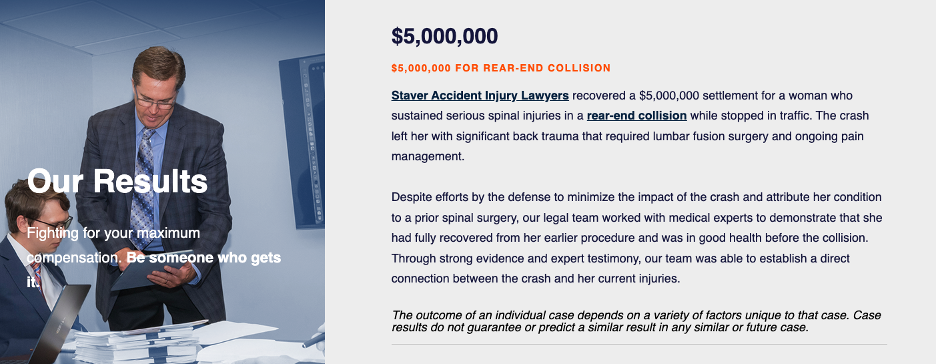
For example, “secured $2.3 million settlement in trucking accident case” carries more weight than “experienced in personal injury.”
Also, years of practice in specific areas matter more than total years licensed, since a lawyer with 15 years in criminal defense has different experience than one who has switched practice areas multiple times.
Case studies, analyses of recent rulings, and insights into local court procedures can also signal experience gained from actual practice rather than theoretical understanding.
Expertise: Where to display attorney credentials for maximum impact
Expertise in the legal context means formal qualifications and specialized knowledge that distinguish attorneys from non-lawyers.
While experience shows what you’ve done, expertise proves you’re qualified to do it through credentials, education, and a deep understanding of legal principles.
Every practicing law firm has credentials. But the question is whether they are visible online so that Google and others who find you can easily validate your expertise.
Attorney credential signals Google looks for
Board certifications from specialized organizations establish elite-level expertise that goes beyond basic bar admission.
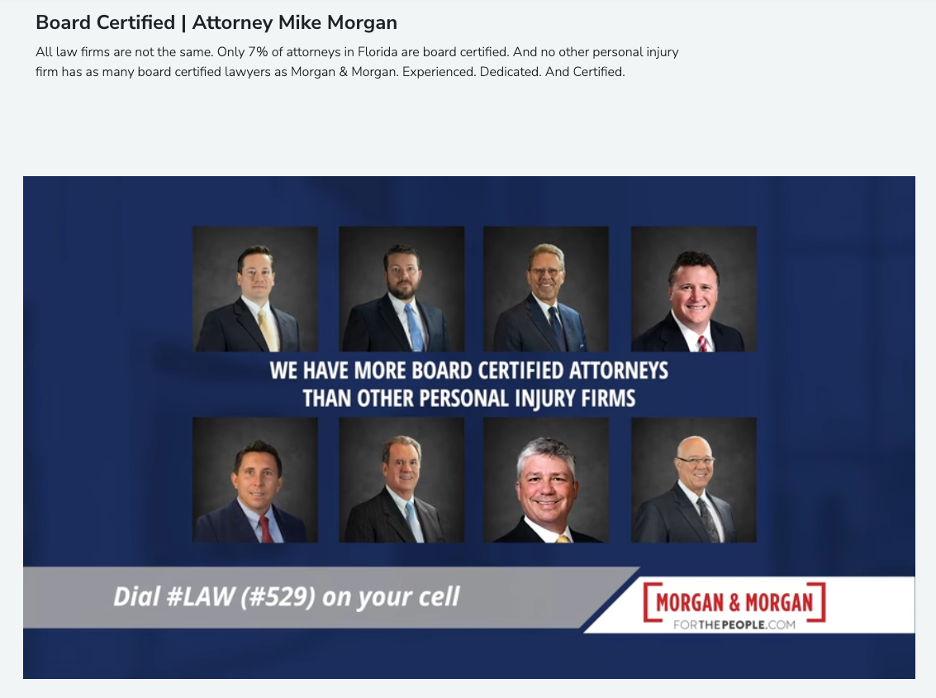
Professional qualifications and academic degrees also signal formal legal training and should be shared for each attorney in your office to build their expertise as individuals.

Professional recognitions such as Super Lawyers, Best Lawyers, and Avvo ratings provide third-party validation of expertise. These credentials should appear in:
- Author bios on relevant articles
- Attorney profile pages
- Practice area pages
- Homepage attorney introductions
Expertise signals go beyond credentials into the content itself. For instance, your practice area pages could combine both approaches by prominently displaying credentials and results while delivering sophisticated legal analysis that only qualified attorneys can provide.
Authoritativeness: How backlinks and citations build your firm’s authority
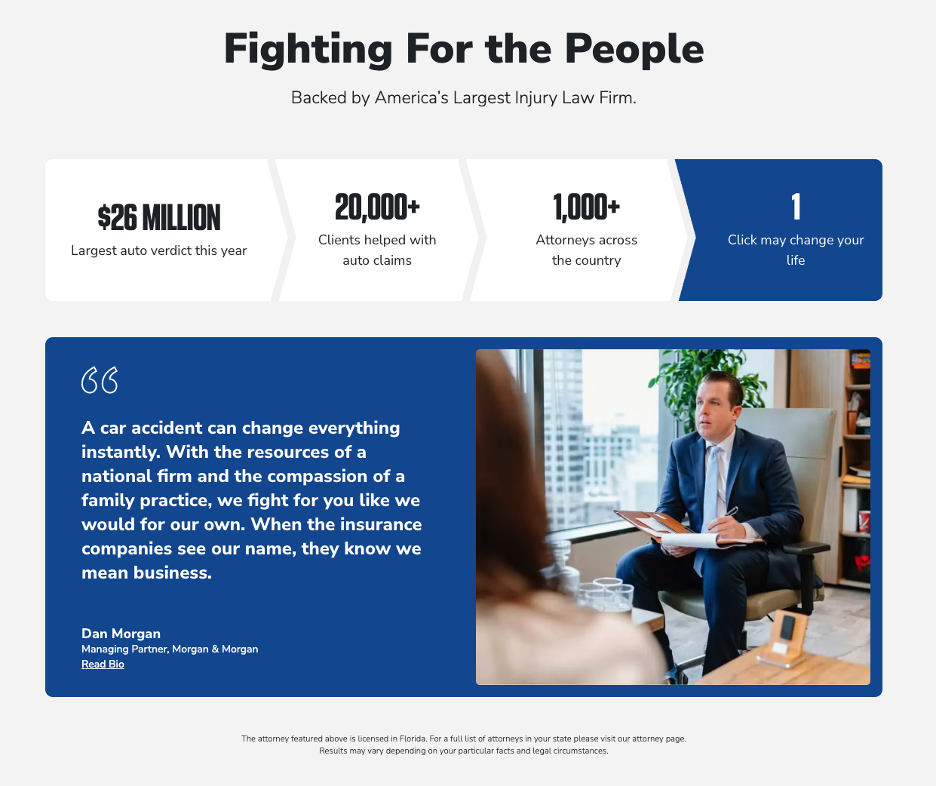
Authoritativeness measures how the broader legal community and reputable third parties recognize your firm’s standing.
Where expertise proves individual qualifications, authority shows that other credible sources recognize your firm’s knowledge and reputation. Google evaluates authority primarily through backlinks, citations, and external reputation signals.
Legal backlinks that carry the most weight
Backlinks from legal-specific sources carry significantly more weight than general business directories.
For example, state bar associations provide some of the strongest authority signals since they represent official licensing bodies.

Legal directories like Avvo, Justia, and FindLaw offer industry-specific validation, while citations in legal publications, law reviews, and legal news sites demonstrate peer recognition.
Awards, speaking engagements, and media citations
Awards and honors such as Super Lawyers, Best Lawyers, and Martindale-Hubbell ratings signal authority through competitive selection processes.

Also, speaking engagements at legal conferences, published articles in industry outlets, and expert commentary quoted in media coverage all demonstrate that outside sources view your firm as authoritative.
Building authority through your own content
Within your own content, thorough legal analysis shows command of complex topics and positions you as an authority in your practice areas.
Original research or analysis of emerging legal issues, citations to primary legal sources like statutes and case law, and regular content updates that reflect current legislation all build internal authority signals that support external validation.
Trustworthiness: The most important EEAT factor for law firms
Trustworthiness is the foundation of EEAT for legal sites because potential clients must feel confident sharing sensitive information and relying on legal guidance.
For YMYL content, trust directly affects whether Google shows your site to people making critical legal decisions. One weak trust signal can drag down everything else you’ve built.
HTTPS, schema markup, and other technical trust factors
HTTPS/SSL certificates are non-negotiable for legal websites, as they encrypt data transmission and display the padlock icon that browsers use to indicate a secure connection. Beyond encryption, several other technical elements also build trust:
- The absence of malware or hacked content (earned through regular website upkeep)
- Professional website design with clean layouts and functional navigation
- Clear contact information, including physical addresses and direct phone numbers
- Appropriate schema markup to provide structured data about your firm in a machine-friendly format
- Privacy policies that comply with data protection standards
- Terms of service that set appropriate attorney-client expectations
Together, these signal legitimacy and transparency, which makes visitors more likely to pick up the phone or fill out a contact form.
How accurate content and client reviews build trust
Accuracy and fact-checking of your own content prevent the kind of misinformation that could harm users following legal advice. Look at the following content elements and how your website uses them to build trustworthiness:
- Citations to authoritative sources like court cases and statutes for verification
- Transparent disclaimers clarifying general information versus specific legal advice
- Updated publication dates showing content reflects current law
- Client reviews and testimonials provide social proof
- BBB ratings offering third-party credibility assessments
- Author profiles that identify who wrote the content and why they’re qualified
If you don’t have a dedicated marketing team, consider hiring professional services to maintain the accuracy of your content as laws change, ensuring trust signals remain current without requiring constant attorney oversight.
How online reputation affects your EEAT and search visibility
Your reputation online matters. Unhappy clients, bad press, common complaints shared in online forums and discussion groups, or even state bar complaints, can all be found online.
Such hits to your reputation affect trust, even when they are not directly visible on your site, since prospective clients often search for disciplinary records before contacting firms.
But now, with the changes in search technology, Google and even AI search platforms can assess your reputation and the sentiment behind every mention of your brand. If there’s a pattern of strong negative feedback about your firm from credible, independent sources, this could affect your visibility in search results.
How FirmPilot builds EEAT signals for your firm
Meeting Google’s EEAT standards requires ongoing work across experience, expertise, authority, and trust signals. For most law firms, that’s a heavy lift on top of actual casework.
That’s where customized, AI-driven law firm marketing changes the equation.

Every piece of content published through FirmPilot pulls from a proprietary database of cases, legislation, and legal news. Your site carries the depth and accuracy Google demands for legal topics, without your attorneys spending billable hours writing blog posts.
What that looks like in practice:
- Content rooted in real legal data, not generic overviews that could come from any firm’s website
- In-depth legal analysis that demonstrates the kind of experience Google looks for in YMYL categories
- Backlinks chosen to demonstrate authority, not just chasing domain scores
- Local competitive analysis that identifies ranking gaps your competitors haven’t closed
- Technical optimization across mobile performance, site speed, and structured data
Your attorneys stay focused on casework. The right clients find you when they search.
Book a demo to see what this looks like in your market.