


Many law firms approach marketing software the way they approach advertising: they buy first and measure later. Maybe you heard about the platform from another attorney at a CLE, signed the contract, and told your team to “figure it out.” Months later, you’re still wondering whether it’s bringing in clients or sitting unused.
As more law firms compete in different ways online, manual marketing workflows are no longer getting results. Firms need automation to reduce hands-on effort and reporting that clearly ties marketing spend to real results. Legal marketing software fills that gap, giving firms the clarity, efficiency, and ROI insight required to compete in an increasingly digital market.
The platforms below help firms convert inquiries into signed clients instead of chasing untracked clicks.
1. FirmPilot: AI-driven marketing platform built for law firms

Most legal marketing software adapts generic business tools for attorneys. FirmPilot was built specifically for law firms, with an AI-driven platform that handles SEO, local search optimization, social media management, website optimization, digital link building, and PPC in one system designed for legal intake workflows and case attribution.
What it does well:
The platform uses AI to identify content opportunities, optimize existing pages for search performance, and track which marketing channels produce actual case revenue. Instead of juggling separate tools for SEO, social media, and paid ads, you’re managing everything from one system that understands legal marketing specifically.
The key differentiator isn’t the channels (lots of platforms handle SEO and PPC). It’s that the system understands legal workflows and uses proprietary data and AI models to target prospects specific to each firm.
Best for:
Firms who are no longer seeing SEO results and manage several marketing channels that require attribution clarity. Works across practice areas (personal injury, family law, criminal defense) since the AI adapts to what your prospects actually search for, not templates built for one case type.
2. Clio Grow: Native integration for the Clio ecosystem
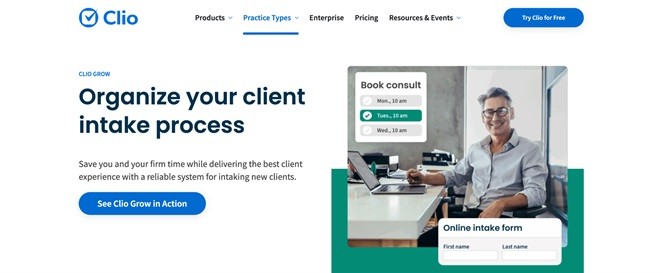
If you already use Clio Manage, Clio Grow makes intake simple through native integration. Client data flows between systems automatically, intake forms populate new matters directly, and document automation pulls from existing case information. Then, use automations to nurture prospects or build your online presence.
What it does well:
No manual data entry between intake and case management. Prospects fill out forms, data appears in Clio Manage, and your team works from one system instead of switching between platforms. The client portal lets prospects upload documents and sign agreements without email back-and-forth.
Best for:
Any firm already using Clio Manage. The integration benefit alone justifies it.
3. Lawmatics: Deep automation for complex intake workflows

Lawmatics handles sophisticated intake sequences that respond to prospect behavior. The automation builder creates workflows based on what prospects do, not just when they inquired. Lead scoring accounts for practice area fit, case value indicators, and engagement signals.
What it does well:
Complex automation that integrates with most practice management systems. Customizable to unusual workflows and specialized practice areas.
Best for:
Mid-size firms with dedicated intake staff who need flexible automation across multiple practice areas.
4. Martindale-Avvo: Directory presence meets lead generation

The Avvo directory still drives traffic for consumer-facing practice areas. Martindale-Avvo captures these inquiries and routes them to your intake system. Leads come pre-qualified by practice area and location, though quality varies significantly by market.
What it does well:
Directory visibility where potential clients already search. Reviews and ratings build credibility with prospects researching attorneys.
Best for:
Consumer-facing practices (family law, criminal defense) where prospects contact multiple attorneys and speed matters more than relationship building.
5. CallRail: Call tracking and recording for phone-driven practices

CallRail tracks which marketing sources generate phone calls and records conversations for training. Dynamic number insertion shows exactly which campaign produced each call, and call recording reveals what’s working (or failing) in your intake conversations.
What it does well:
Attribution for phone leads. Integration with Google Ads and Facebook feeds conversion data back to ad platforms so algorithms optimize toward calls that convert.
Best for:
Firms where prospects call instead of filling out forms. Essential for practices spending money on advertising.
6. Unbounce: Landing pages for serious paid campaigns

Unbounce builds landing pages specifically for paid traffic. Someone clicking your ad sees a page about that exact service, not your homepage. Drag-and-drop builder lets non-technical staff create and test pages without developer help. A/B testing shows what actually converts.
Best for:
Firms spending thousands monthly on Google Ads or Facebook who need better conversion rates from paid traffic.
Platform comparison
| Platform | Best for | Key strength | Best firm size |
| FirmPilot | Firms wanting AI-driven marketing | Using data and AI to better target prospects and rank higher | Small to mid-size firms looking to strategically gain online visibility |
| Clio Grow | Existing Clio Manage users | Native integration with Clio ecosystem | Any size firm already using Clio Manage |
| Lawmatics | Mid-size firms needing complex automation | Deep workflow customization | Mid-size firms (4-15 attorneys) with dedicated intake staff |
| Martindale-Avvo | Consumer practices needing lead volume | Directory visibility and brand recognition | Solo to small firms (1-5 attorneys) in consumer-facing practice areas |
| CallRail | Phone-driven practices | Call attribution and recording | Any firm spending money on advertising where prospects call |
| Unbounce | Firms running serious paid campaigns | Landing page optimization and testing | Firms looking to get ROI on their paid campaigns |
What firms should look for in legal marketing software
Beyond generating leads, the right platform turns effort into signed cases, reduces manual work, and scales as competition increases.
Before comparing tools, law firms should evaluate software across a few core areas:
Clear attribution to leads and revenue. You should be able to discern from your marketing stack whether you’re signing more, better clients. Metrics like clicks and form fills matter less than knowing which channels produce real revenue.
Automation that reduces manual work. Marketing software should eliminate busywork, not add to it. Strong platforms automate follow-up, intake workflows, and reporting so staff aren’t stitching systems together by hand.
Fit with legal intake workflows. Most marketing tools aren’t built for law firms. The right software supports practice-area logic, integrates with case management systems, and aligns with how firms evaluate leads.
Flexibility across channels and growth. Firms use multiple channels, and that mix changes over time. Good software supports SEO, ads, referrals, and calls without siloed reporting or rigid workflows.
Reporting that drives decisions. Dashboards only matter if they change behavior. Reporting should make it clear where to invest more, what to pause, and where leads drop off before signing.
Ultimately, the best legal marketing software doesn’t just try to push the old playbook through a new workflow, it gives firms new opportunities to grow faster and scale more quickly.
Expensive mistakes to avoid
By the same token, it’s important to know common pitfalls (and how to avoid them).
- Don’t buy software your staff won’t use. The most powerful platform in the world won’t help if your intake team hates the interface and finds workarounds. Bring them into the evaluation process early so they can flag problems before you sign anything.
- Verify every integration before you buy. Test how data moves between your real systems, not just what the sales rep shows you. Many “native integrations” fail after updates and turn into manual data entry. If information is being retyped between platforms, the systems are not truly connected.
- Invest in proper training. Every new platform needs a real onboarding period, not a quick demo and a login. Block time during the first month for structured training and include that cost in your implementation budget.
- Measure the metrics that matter. Lead volume looks good on paper but means nothing if it does not turn into retained clients. Signed cases are only part of the picture. Track revenue back to the marketing source to see which channels are actually driving growth.
How FirmPilot fits into your marketing stack
FirmPilot handles AI-driven content creation and optimization specifically for law firms, then tracks how your firm is building visibility, particularly compared to competitors.
What you get:
- AI-powered content creation and optimization based on what prospects actually search for
- On-demand reporting so you can see how rankings are increasing
- One system for SEO, local search, social media, PPC, and PR instead of juggling multiple platforms
Whether you’re solo or running multiple locations, you get clarity on what’s working and the ability to reallocate budget toward channels that drive revenue.
Book a demo to see how FirmPilot tracks your specific marketing channels and feeds settlement data back into campaign optimization.