


Personal injury is the most competitive practice area in legal marketing, with local firms dealing with “big box” law firms coming in and bringing large advertising budgets with them. All while hearing about how the practice of law is changing, but not having time to train and adopt to new methods. With 37% of personal injury attorneys adopting AI, it is one of the practice areas with the highest adoption.
The cost of falling behind is no longer abstract. Firms running AI sign intake in minutes, draft demands in hours, and can do a first pass on 3,000-page medical records in an afternoon. The firms still doing it manually lose those cases to the ones that don’t.
This guide covers 10 AI tools for personal injury lawyers across five workflows: case management, medical record review, demand letter drafting, intake, and client acquisition. Top picks include Supio for medical chronology, EvenUp for demand drafting, Filevine for case management, and FirmPilot for AI-powered legal marketing. Every entry covers what the tool does, who it’s built for, the workflow it accelerates, and one honest limitation.
Disclosure: FirmPilot publishes this content and is included on this list. All tools were evaluated against the same criteria: PI-specific workflow fit, observable product capabilities, and user-reported strengths and limitations.
How we selected these AI tools for personal injury lawyers
We mapped the PI case lifecycle from marketing to settlement, then identified tools that automate a specific step rather than generic “legal AI” platforms.
Selection criteria:
- PI-specific use cases. Generic legal AI platforms were excluded in favor of tools with PI workflow fit.
- Public pricing or transparent demo access. Tools that hide behind opaque sales processes were deprioritized.
- Verifiable user reviews. G2, Capterra, and Reddit’s r/Lawyertalk and r/personalinjury were used to validate user-reported strengths and limitations.
Adoption sequence most PI firms follow:
- Case management
- Medical records AI
- Demand drafting
- General legal research
- Marketing AI
The entries below are ordered to reflect where most firms are in that journey.
Quick comparison: AI tools for personal injury lawyers
Workflow, best-fit firm size, and pricing visibility for each tool are covered below.
| Tool | Workflow accelerated | Best for | Pricing visibility |
|---|---|---|---|
| Supio | Medical chronology and case summary | Mid-large PI firms with heavy medical record volume | Quote only |
| EvenUp | Demand letter drafting | Firms doing 20+ demands per month | Per-demand pricing |
| Filevine | Multi-practice case management | Firms running PI alongside other practice areas | Quote |
| CASEpeer | PI-native case management | Small to mid-size PI firms | Public tiers |
| Litify | Enterprise PI litigation | PI firms with 50+ attorneys and multiple offices | Quote (~$200/user/mo) |
| Eve | Nightly case auditing and drafting | PI firms with case backlogs | Quote |
| CoCounsel | Research and deposition prep | PI firms doing complex litigation | Quote |
| Lexis+ AI | Jurisdiction-aware research | Multi-state PI practices | Lexis subscription add-on |
| Lawmatics | Intake automation and nurture | Firms where intake volume is the bottleneck | Public tiers |
| FirmPilot | Marketing, SEO, GEO, and attribution | PI firms tying marketing spend to signed cases | Quote based on tiers |
1. Supio: Top AI tool for medical chronology and case intelligence
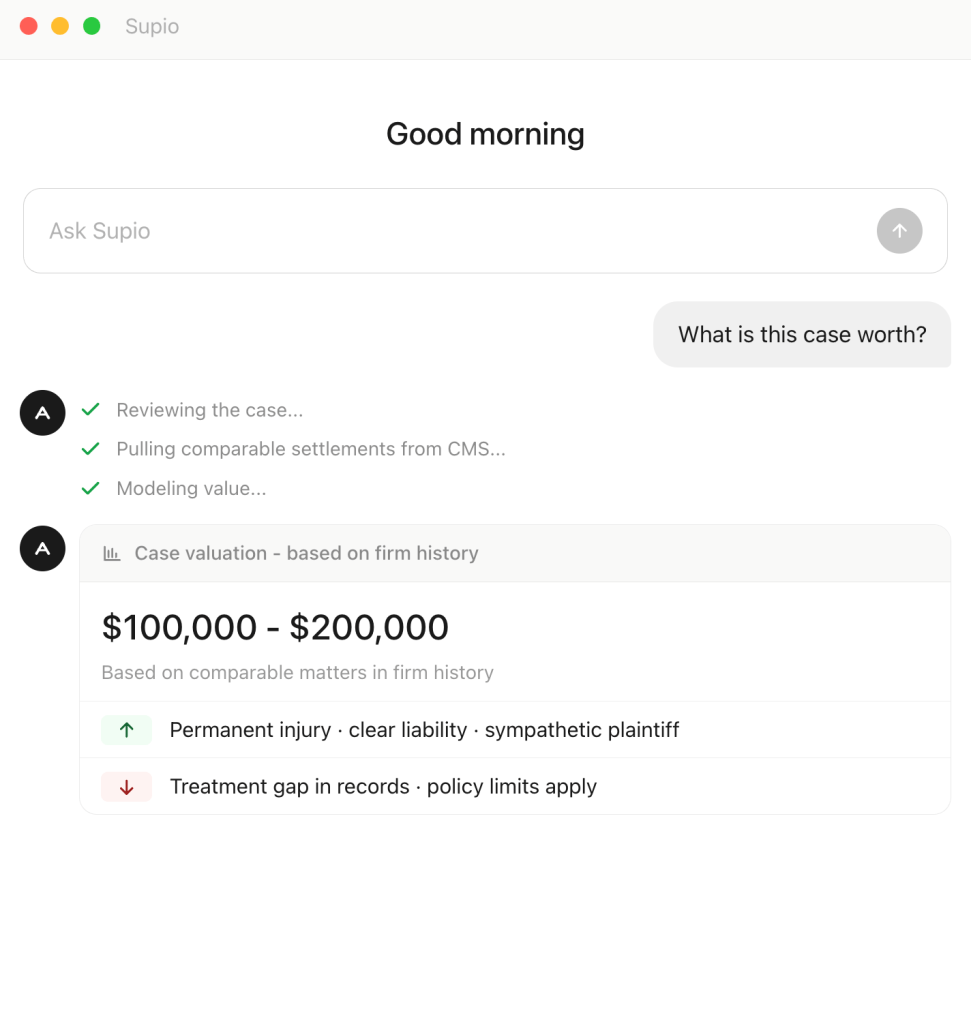
Supio is an AI platform built for PI firms that ingests documents such as medical records, depositions, and case files, then produces litigation materials including chronologies and summaries that would take a paralegal days. The chronology engine reads handwritten provider notes, imaging reports, and billing records, then outputs a timeline ready for demand drafting or deposition prep.
What lands back is a date-ordered timeline with every diagnosis code, provider, and treatment cost extracted into structured fields, ready to hand off to a paralegal or pull into a demand draft.
- Reads handwritten chart notes, dictated specialist reports, ER triage records, and ICD-10 coded billing
- Outputs a date-ordered timeline with provider names, diagnoses, and treatment costs already extracted
- Every entry cites back to a page in the source record so attorney verification is fast
- Feeds directly into demand drafting and deposition prep without re-entering data
Best for: Mid-to-large PI firms handling complex or high-value cases where medical record volume is the bottleneck.
What we like: The chronology output cites back to the source page in the underlying record, so attorney review is fast.
Watch out for: Transparent pricing unavailable; contact for quote. Smaller firms with lower case volume struggle to justify the spend against a more demand-focused tool.
2. EvenUp: Best AI demand letter tool for personal injury firms

EvenUp is the most established AI demand letter platform in the PI market. Upload medical records, billing, and case facts, and EvenUp produces a draft demand with damages calculations, medical summaries, and settlement value estimates. Firms report demand drafts compressing from full-day tasks into 60 to 90 minutes of attorney review.
The company also offers a professional review option with standard turnaround of about five to ten business days on the core plan, faster options available. The settlement value estimate is often more useful than the draft itself, because it gives the attorney an anchor to push back on a low first offer.
- Upload medical records, billing, police reports, and case facts to start the draft
- Receive a draft demand with itemized medical summaries and damages calculations
- Settlement value estimates anchored to comparable verdicts in EvenUp’s database, not pulled from thin air
- Attorney review still required for liens, letters of protection, and the future damages narrative
Best for: PI firms doing 20+ demands per month where draft turnaround constrains settlement velocity.
What we like: Settlement value estimates are anchored to comparable verdicts and settlements, not pulled from thin air.
Watch out for: Attorney-in-the-loop is non-negotiable. Settlement estimates going to a client should be reviewed against the attorney’s own market knowledge, and demand drafts need a careful read before filing.
3. Filevine: AI tool for case management
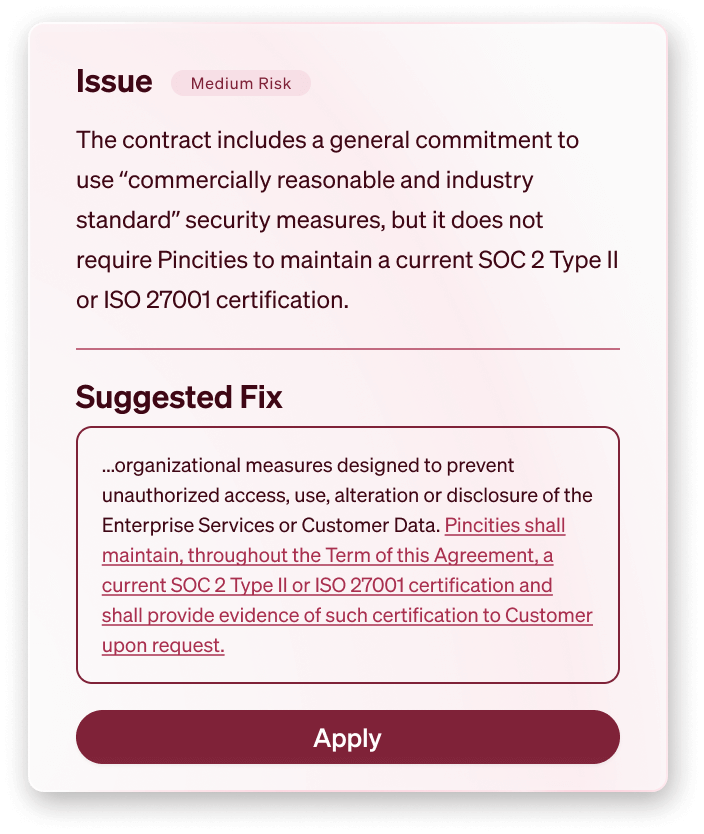
Filevine is a case management platform with AI layered into document review, deadline tracking, and demand letter generation. Filevine serves multiple practice areas, which means broader integrations and more granular workflow customization than PI-only platforms.
The customization is both the draw and the trap. Customizable templates let firms encode their actual intake-to-settlement workflow, but firms that skip the configuration phase end up running default templates that do not fit how they work cases.
- Case management built around customizable project types and phase-based workflow automation
- AIFields extracts structured data from documents into specific case file fields, with OCR that reads handwritten notes and images
- Document review AI surfaces missing records and inconsistencies during case workup
- Implementation typically runs four to eight weeks with a certified partner, and eight to twelve for complex migrations; firms rarely self-onboard
Best for: PI firms that want one platform across case management, document automation, and lighter demand drafting without bolting on a separate demand tool.
What we like: The document review AI surfaces missing records and inconsistencies in the file. Customizable project templates let firms encode their own workflows.
Watch out for: Pricing is quote-based (starting around $87/user/month) and implementation is heavier than PI-native platforms. Firms may underestimate the configuration work and end up with a half-built system. User reviews also cite a learning curve and slower support.
4. CASEpeer: AI tool built for PI-native case management

CASEpeer was built for PI from day one. Settlement calculators, medical records management, and lien tracking are core to the product rather than add-ons. The interface mirrors how PI firms actually run cases: intake, treatment, demand, negotiation, settlement.
The settlement calculator handles attorney fees, costs, medical liens, and net to client in one view. Lien tracking integrates with health insurers and the Medicare conditional payment process that otherwise eats hours on the phone.
- PI-specific case stages built in: intake, treatment, demand, negotiation, settlement
- Settlement calculator with fees, costs, liens, and net-to-client in a single screen
- Lien tracking integrated with health insurers and Medicare conditional payments
- Reporting on attorney workload and case status available out of the box
Best for: Small to mid-size PI firms that want a platform without configuration overhead.
What we like: The settlement calculator and lien tracking reduce settlement calculation and lien tracking time by several hours per week. Reporting on case status and attorney workload is built in.
Watch out for: AI features are lighter than what you’ll find on Filevine or Litify. Firms that want heavier AI document review will outgrow it.
5. Litify: Best for enterprise PI litigation

Litify is built on Salesforce and targets larger PI firms with complex litigation workflows. The platform ships AI agents for specific litigation stages, from intake through trial prep. For firms managing hundreds of active cases across multiple offices, Litify scales where lighter platforms break.
Sitting on Salesforce means Litify inherits the strengths (deep reporting, customization, integrations) and the costs (admin overhead, slower changes). Expect $200+ per user per month all-in and a four to six month implementation runway.
- Built on the Salesforce platform with enterprise-grade customization
- AI agents covering intake, discovery, and trial prep workflows
- Multi-office reporting and case attribution at scale
- Requires a dedicated Salesforce admin to keep the system tuned
Best for: Enterprise PI firms (50+ attorneys) with multi-office operations.
What we like: The Salesforce foundation means reporting, integrations, and customization run deep at the high end.
Watch out for: Cost and implementation timeline. Litify is not a fit for firms under 20 attorneys.
6. Eve: Best for nightly case auditing
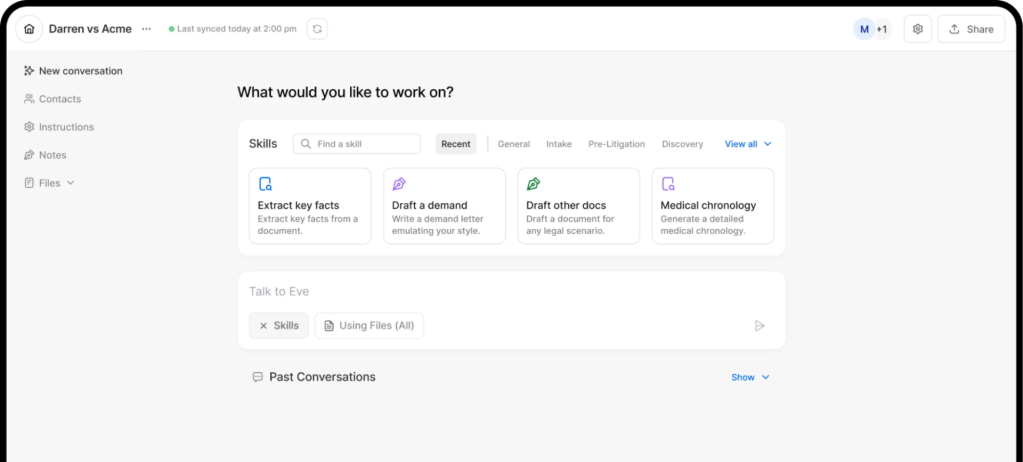
Eve is an AI litigation platform that learns your firm’s operations and writing style. Its AI Auditor reviews active cases each night and surfaces missing drivers: undiagnosed TBIs, missed MRIs, mass tort eligibility, gaps in treatment records that hurt damages.
The Auditor runs while the office is closed and surfaces gaps that hurt damages on cases sitting in inventory: undiagnosed TBI signs in primary care notes, missed imaging on neck and back cases, and treatment gaps that weaken causation.
- Nightly AI Auditor reviews active cases for missed value drivers
- AI Drafter writes demands and pleadings tuned to the firm’s voice
- Flags undiagnosed TBI signs, missing imaging, treatment gaps, and mass tort eligibility
- Newer platform with a fast-moving roadmap and fewer entrenched users than EvenUp
Best for: PI firms where cases sit in inventory and partners worry about value being left on the table.
What we like: The Auditor catches gaps a human reviewer misses on case 200 of 300. The writing-style adaptation produces drafts that don’t need a full rewrite.
Watch out for: Eve is newer than EvenUp or Supio. The roadmap is moving fast, but firms standardizing today are betting on a younger product.
7. CoCounsel: AI tool for legal research and document review

CoCounsel from Thomson Reuters handles legal research, document review, deposition prep, and contract analysis. For PI firms, the value is in deposition prep and document review on larger cases where research time stacks up.
For deposition prep, AI reads transcripts and surfaces inconsistencies that a manual review of a 200-page depo will miss, then drafts cross-examination outlines from the findings.
- Legal research with citations grounded in Westlaw
- Deposition prep with transcript review, inconsistency detection, and outline drafting
- Document review and contract analysis at scale
- Overlaps with Filevine’s document review AI, so audit the stack before paying for both
Best for: PI firms doing complex litigation that need research depth beyond what case management AI provides.
What we like: Underlying citations are sourced from Westlaw, which matters for anything going into a pleading.
Watch out for: Firms paying for Filevine AI and CoCounsel often realize they’re paying twice for similar document review.
8. Lexis+ AI: Best for jurisdiction-aware citation
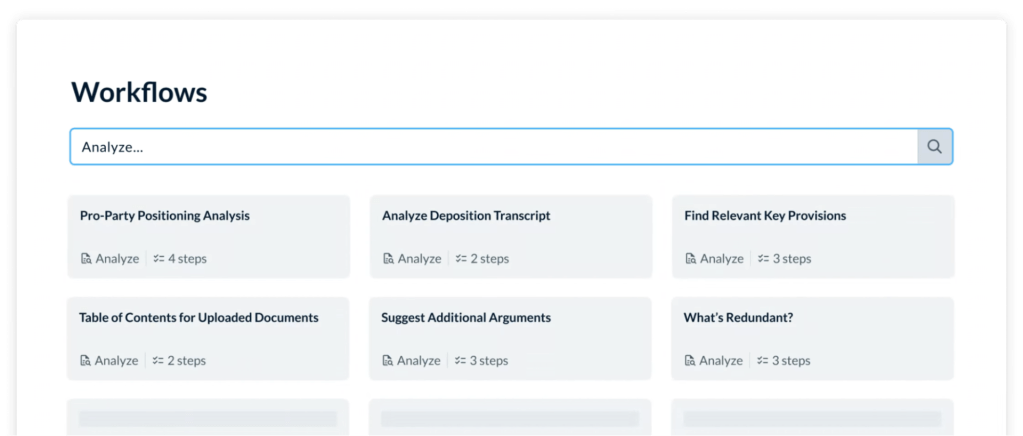
Lexis+ AI is built on the LexisNexis research database with jurisdiction-aware citation generation. For PI firms, the value is fast research on state-specific damages caps, comparative negligence rules (degree of plaintiff fault), and recent verdicts.
For PI work specifically, the platform earns its keep on state damages caps, modified versus pure comparative negligence rules, and recent verdict lookups in your jurisdiction. Bad cites still slip through and need manual review before filing.
- Jurisdiction-aware research grounded in the LexisNexis case database
- Damages caps, comparative negligence rules, and recent verdict lookups
- Citation accuracy stronger than general AI tools but not perfect
- Verify every cite before filing, regardless of which AI generated it
Best for: PI firms operating in multiple jurisdictions where state-specific research is a recurring need.
What we like: Citation accuracy is stronger than general-purpose AI tools because the model is grounded in the Lexis database.
Watch out for: Hallucination risk is lower than open AI tools but not zero. Verify every citation that goes into a pleading.
9. Lawmatics: AI tool for intake automation
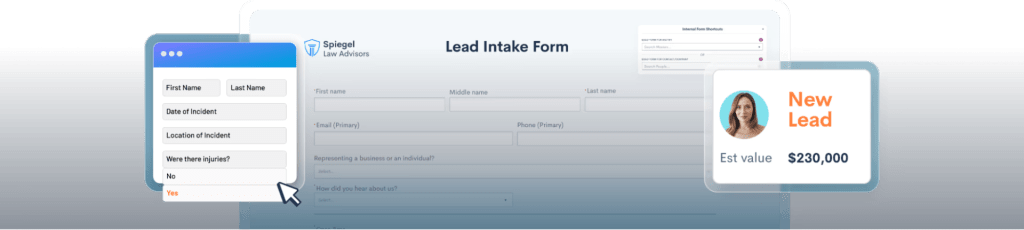
Lawmatics handles client intake, marketing automation, and lead nurturing. Intake forms feed the CRM, QualifyAI scores and qualifies incoming leads against your firm’s own criteria, and automated workflows route the qualified ones to the right person. Firms using Lawmatics typically cut intake response time from hours to minutes.
Speed wins PI cases. The first attorney to call back signs the client. Lawmatics routes a new lead into the CRM the moment it hits the website, triggers the follow-up workflow, and keeps the prospect in a nurture sequence until they convert or drop out.
- Intake forms feed the CRM with automated lead scoring, qualification, and routing
- QualifyAI recommends next steps and can trigger workflows automatically based on lead quality
- Drip campaigns and nurture sequences for slow-converting leads
- Built to receive leads, not generate them; pair with a marketing tool for the full funnel
Best for: PI firms where intake volume is high and lead response speed determines signed cases.
What we like: QualifyAI scores leads on firm-specific criteria and automates the next step, so high-value prospects trigger immediate outreach instead of sitting in a queue.
Watch out for: Lawmatics handles intake and nurture, not marketing. Firms still need a separate solution for getting qualified leads to the door. Pricing is quote-based, so expect a sales conversation rather than a public rate card.
10. FirmPilot: Best AI tool for personal injury lawyer marketing
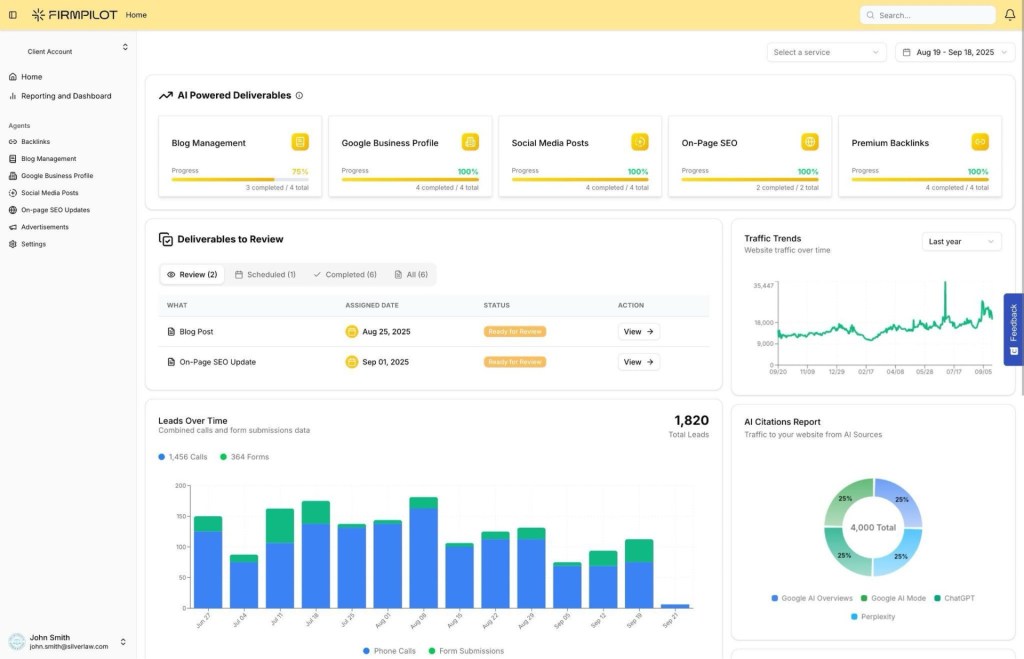
FirmPilot is the AI marketing platform built specifically for law firms. Where Lawmatics handles what happens after the lead arrives, FirmPilot handles getting the lead in the first place. The FirmPilot AI engine is trained on 5+ million pieces of legal content and continuously monitors what competitors rank for, what content they publish, and where the gaps are. In combination, FirmPilot’s content agents create content with the authority to increase rankings and visibility.
FirmPilot is also built for GEO (Generative Engine Optimization, the practice of optimizing for AI-generated search responses), positioning firms to appear in answers from ChatGPT, AI Overviews, and Claude. One SEO page that earns a top position keeps producing signed cases month after month, turning a single piece of content into a recurring acquisition channel rather than a one-time ad spend. For paid acquisition, FirmPilot manages PPC alongside SEO so attribution from spend to signed case is clear.
The content agents write practice-area pages for PI sub-verticals (car accidents, motorcycle, truck, premises liability, dog bite), each targeted at real queries running in your specific geographic market. The result is a content footprint that compounds instead of a stack of one-off blog posts.
- Practice-area pages generated for PI sub-verticals and tuned to your geographic market
- Real-time dashboards showing rankings, traffic, and lead source attribution by channel
- GEO optimization for ChatGPT, Perplexity, and Google AI Overviews
- Competitive Blueprinting tracks what competitors rank for and where the gaps are
Best for: PI firms seeking better targeting and faster turnarounds with their digital marketing.
What we like: Flat monthly pricing instead of percentage-of-ad-spend. Real-time dashboards instead of monthly reports. Customer results include 180%+ more qualified leads in three to six months. Backed by $11.7M from Thomson Reuters Ventures, HubSpot Ventures, and Blumberg Capital.
Watch out for: FirmPilot is a marketing platform, not an intake solution. Pair it with Lawmatics or Clio Grow for the full funnel.
Where firms get the AI stack wrong
- Overlooking the entire case lifecycle. Firms buy AI for the stage that hurts most today and leave the rest of the lifecycle manual, so the bottleneck just moves. Map the full path from marketing through settlement first, then fill the gaps in sequence.
- Buying features instead of workflows. A slick feature demos well. It only pays off if it fits how your firm actually works a case. Buy the tool that fixes a workflow you can name, not the one with the longest feature list.
- Underestimating implementation and adoption. The contract is the easy part. Configuration, data migration, and training are where timelines slip and firms end up with a half-built system. Budget for the rollout, not just the license.
- Confusing intake with marketing. Intake tools work leads you already have. They do not generate new ones. If your pipeline is thin, a faster intake process just qualifies the same small pool of cases.
- Paying for AI nobody actually uses. Software you pay for and your team ignores is pure waste. Pick tools your staff will actually adopt, then check usage against the invoice every six months.
- Building the stack without a unified vision. Firms add tools one problem at a time and end up with systems that do not talk to each other. Decide what your stack should look like end to end first, then buy toward that, not away from today’s fire.
Build the stack, win the qualified cases
Running the full AI stack across the PI workflow changes the economics of the firm. More cases per attorney. Demands drafted in hours. Medical review brought in-house. Marketing that targets the qualified PI cases you actually want to sign. FirmPilot handles the acquisition layer, getting qualified PI cases to your door with marketing built on legal-specific AI and transparent reporting.
In a 30-minute walkthrough, you will see:
- Where your firm currently ranks for PI keywords in your geographic market
- The content gaps your competitors are exploiting and the queries you are losing
- How attribution flows from ad spend through to signed case revenue in the dashboard
- Flat monthly pricing with no percentage of ad spend and no surprise invoices
Book a demo and stop guessing which channels produce signed PI cases.