
We would love to see every firm succeed and rank for the #1 spot on Google for every keyword they’d like. Unfortunately, it’s not that easy. Not only do you need good content, google reviews, backlinks, and a ton of other things; but you also need a FAST website. Yes speed matters, we are taking microseconds sometimes.
Google, the kingmaker and most popular search engine, considers over 200 factors to analyze billions of websites and search queries. They have a pretty sophisticated algorithm for grading your website’s speed, accessibility, and usability because no human is grading billions of website pages.
Why do we care about this? Google enjoys 91.5%of the search engine pie, making it the ultimate lead machine for law firms all over. So, if you’re not actively refining your SEO strategy, which includes your website grade, you’ll miss out on massive traffic (potential clients).
With 10,000+ people googling for attorneys or a legal question daily, something magical happens when you land one of the top three spots for a valuable keyword or phrase. You don’t need to rank for “best injury lawyer” or “top divorce law firm.” While those keywords and phrases may have 10k+ searches a day, there are still hundreds of other more ‘niche’ keywords that are still super valuable. These long-tail keywords actually have higher conversion rates even though they have lower search volume (learn more about long-tail keywords in chapter 1: SEO keywords for attorneys). When you rank for these keywords in your area such: as “how much is a divorce attorney in dallas” or “how long does it take to apply for a green card.” These long-tail keywords are achievable, however, they still require a well-graded website.
If you are asking, “How do I rank at the top?” Good news: this chapter is about how google grades websites when it comes to ranking (on and off-page factors) and shares some of our secret sauce that we use here at FirmPilot. We’ll discuss the tactics attorneys need to see an ROI from SEO and google ads:
We’ve all what is possible and what is not from ‘people who have been in the biz for years.‘ The truth is, none of us work at google or facebook, and what matters in marketing continually changes and evolves. Plus, there is enough business to go around to every one that does high-quality marketing and is patient.
Most search engines (think Google, Firefox, Opera) use numerous factors to analyze web pages worldwide. What does this mean for your law firm’s website? The browser will evaluate and match your site to these factors to identify where (and how) to place it in front of the eyes of your clients.
Here’s what we suggest you need to highly consider when designing or fixing your website:

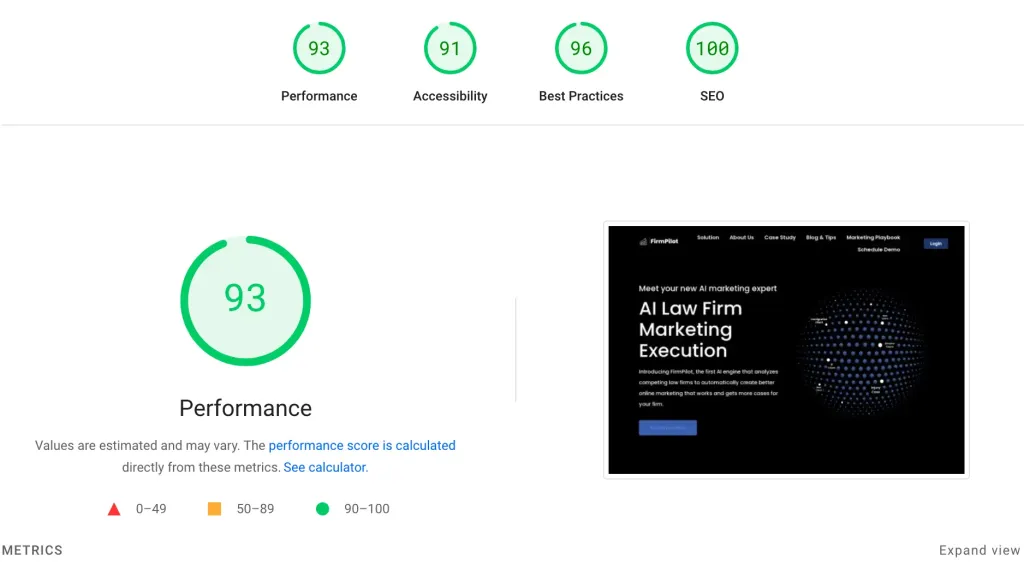
…amongst many other factors. We realize these are not simple tasks. Fortunately, we use our own AI website marketing engine, FirmPilot, to improve our site’s grades. Below are some easier wins to improve your site.
Whether you bought your law firm’s domain in 2016 or starting your attorney website, you’ve likely heard the terms’ backlinks’ or ‘linking ecosystem.’ If you’re nodding your head, wondering, “Yes, but what is it, and does it matter for my firm?” – the answer is yes, links do matter to you.
Google refreshes and tailors its algorithm to its (and the user’s) evolving needs. However, good links have been a primary factor since Google’s introduction of its PageRank algorithm. What does this mean for attorneys trying to grow their firm through SEO and ads? The quantity and quality of sources can make or break your ranking position.
For the browser, your backlinks are thumbs up for the original content piece. It tells Google, “This copy is authoritative; it has the info folks want to solve their queries,” the search engine takes the site higher on its results page.
If you’re scratching your head, thinking, “I really don’t understand what this means,” think of it like the elections. You want the most qualified person to take the presidential seat, so you give them as many votes as possible. So, now we’ve got linking covered, but what’s a “high-quality” backlink?
If you’re a more visual person like me, here’s a quick video explaining PageRank:
If you’re thinking, “What?! Does it make that big of a difference?” the answer is yes. Google’s web crawlers will evaluate every factor (after all, a billion copies compete for the top spots!). So, what happens when you backlink to a reputable law firm site within your article?
You show Google that the link is deliberate, giving the website your vote of confidence while demonstrating your authority.
Picture this: a website backlinks to your top-rated article. You’re feeling excited and jittery and think it’s a fantastic opportunity to increase your SERP ranking. But how do you determine the “link juice” your law firm’s site earns from this backlink?
SEO tools like Ahrefs and Moz offer an in-depth URL Rating (UR) to pinpoint the website’s authority. So, how does this work? If I put an anonymous law firm’s website in Ahrefs Website Authority Checker, we get the following result:

What does this domain rating tell us? This particular example firm’s article has an average DR and can rank in the top ten search engine results.
The domain range metric speaks volumes about a website but isn’t the only one that matters. What else do law firm sites have to consider? The number of URLs from a website and how many are do-follows.
If we return to the above example, most of its linking sites and backlinks are do-follow:
How does this affect your website’s Google ranking? A no-follow attribute can cause Google not to pass PageRank, meaning your ranking can fall significantly.
You want to rank first on Google’s SERPs, and so do millions of law firms. So, how do you stand out and show the search engine you deserve the #1 spot? It starts with building captivating and relevant content that meets folks’ needs and goes in-depth.
How do you optimize your content to capture those sweet three search results? You ensure your substance has topical relevance and is authoritative; that shows Google your site’s worth. What about the word count, you ask?
According to studies, the top organic search results on Google contain approximately 1,447 words. In addition, approximately 88% of search queries comprise three or fewer words. So, how does this help you rank better? It offers insights into the keywords you should incorporate into your content.
For instance, if I write an article on “Things to Know about a Law Firm, “Ahref provides the following KW list:

With the keyword density and volume metrics, I can create a list of tangible phrases to support my copy and hack the Google algorithm. You’ll want to sprinkle long-tail keywords and questions into your articles to reach the top five search results.
Still trying to figure out why! Ahrefs and Moz’s in-depth studies found that 29%of KWs involve 3+ words and over 8% are queries. So, how do you ensure you’ve fully optimized your site? You add keywords in the title, headings, anchor, and body and create a clean, easy-to-follow format.
Many tech giants invest millions to revolutionize their algorithms (thus why digital marketers must always be on their toes!), and Google is no different. The search engine leverages RankBrain, an innovative ML algorithm that weighs hundreds of factors to ensure folks get the best search results.
You’re likely wondering how RankBrain works and what it means for my attorney website, right? Through RankBrain (see below), Google interprets the user’s query to provide accurate and quick results.

While the algorithm is far more complicated than this short flow chart, it’s a distilled version of the intricate workings of RankBrain. So, how can law firms like you optimize sites to beat RankBrain? Start by determining the parent KW phrases for your topic.
Let’s look at an example from Ahrefs:

The exciting tool offers ideas on targeting a more general niche while ranking for a specific phrase or term. For instance, if I put “how to build a niche site” as my query, Ahrefs tells us the parent topic is “Niche Site” with a search volume 200. Since it’s higher than 30 for the provided input, you’re better off using the parent topic!
So, what are other ways to optimize your law firm site? Craft vivid, attention-grabbing titles and meta descriptions that make folks go, “Whoa! This article sounds interesting!” This will help take your click-through rates to the next level!
One mistake to avoid in these two categories is to use your contact info. Websites that use phone numbers and emails in the meta title turn off prospects. Thus, Google sees a website with a poor CTR and takes your ranking down. There’s one last factor, and what’s that?
The site’s dwell time indicates the time viewers spend scrolling on your site. The one (proven) way to boost this is to incorporate flashy visuals, captivating videos, and an engaging format.
Like most search engines, Google’s algorithm hyper-focuses on viewer search queries and the site’s content. And how can you use this knowledge to boost your law firm’s ranking on the search result page?
Good question- we’ll delve into that in the following five insights! We’ve analyzed Google’s complex algorithm to bring you these foolproof tips:
Do you know that search intent has become the new buzzword of the SEO world? Wondering what it means and why it is crucial? Although many websites may find it challenging to fit the Google search results, with this buzzword surfacing the internet for good, it has become easier to determine whether the website is a perfect fit for a specific keyword. Thanks to RankBrain, which has made it possible.
This helps Google to pay attention to understand the ways people interact with our website. If people find answers to queries, they search online on your webpage, improving your rankings and search results.
And if you fail to provide meaningful information to internet users, Google drops your online rankings. The key is to ensure that your website offers the correct and precise information to the online users. Moreover, it should answer the exact queries people are looking for.
Let’s take an example:
The keyword Conversion Rate Optimization did pretty well initially when you wanted to optimize your website. So, you spent weeks working on the giant list of CRO techniques to improve the rankings. At first, you received excellent results, with many online users searching for the same term every month.

However, later, Google realized that people looking for Conversion Rate Optimization did not want a massive list of techniques. Therefore, the web traffic to the page slowly declines.

After some time, you figure out the search intent of the online users when they look for the term Conversion Rate Optimization.
Initially, you need to determine the intent of the user who types the keyword in the Google search engine. Then, you must realize the content or the search results Google shows. These results may include the following:
Then, search the internet to understand what the most visited websites display in their content. This way, you will understand what your web content is missing. You can use these search results to revamp your content so that it displays on the first page of Google search results.
We all want to publish excellent content. But how many of us can do that? Well, you need to understand a few crucial things when publishing content online – backlinking! It is one of the best ways to drive traffic to your website.
Otherwise, many publish their content, hoping internet users magically land on their websites. Well, that’s not the case with the internet! You need the right keywords and backlinks to drive users to your website.
According to a WordPress report, over 70 million new posts appear online monthly. Isn’t this number huge? With this number, it is crucial to use the proper techniques to ensure heavy website traffic. The critical takeaway is to promote your website if you want more people to visit your website.
We all know the importance of adding visuals to our websites. Since we, as internet users, also look for eye-catching websites that display infographics, pictures, and vibrant visuals to keep us connected to the website, we must also understand the psyche of other readers.
Visuals have a significant role in keeping your readers hooked to your website. No one would want to scroll through a website with dry, non-vibrant content! Would you? No, right! That is why adding images to your websites is crucial when publishing content. There are numerous reasons why websites add photos to their content.
It saves them from copyright violation. Adding images creates awareness about the domain, services, and products. This makes it easier for the readers to recognize you on the internet. Moreover, these visuals create great opportunities to build backlinks. Rich content with valuable content and appealing images boosts traffic and ranks your website higher in search results.
Law firms must master SEO to secure top rankings on Google search results. This will allow them to reach potential clients and attract qualified leads. Moreover, understanding Google’s algorithm may be challenging at first.
However, if you add backlinks to relevant content and understand the user’s intent when publishing it, you will ace it. Furthermore, make sure to balance out your content with visual elements to optimize your website.