


Most law firms know their monthly paid search spend to the dollar. Far fewer can say which clicks produced their last five clients.
Industry research finds 82% of firms running paid search report underwhelming returns, even though legal clicks are the most expensive in digital advertising.
Closing that gap comes down to what legal clicks actually cost, how campaigns get split by practice area, and how far you can trace spend past the first click.
Key Takeaways
- Legal paid search averages $9.87 per click, the highest of any tracked industry. That price raises the cost of every wasted click.
- Most firms stop measuring at cost per lead. Firms that track from click to retained client can see which spend actually produces cases.
- Google Ads and Local Services Ads serve different roles and often work best together. LSAs bring trust signals and pay-per-lead pricing. Google Ads bring precise targeting control.
- Google’s AI Max poses real risks to law firms, including low-intent query expansion and auto-generated copy that may conflict with bar advertising rules. Configuration discipline matters even more once automation takes over.
- FirmPilot provides AI-driven PPC management built for law firms, with real-time reporting that ties campaign spend to the leads each campaign produces.
Law firm paid search in 2026 is more than buying ads
Most firms think paid search is one decision: what to spend. In 2026 it’s four. Which platforms you run. How campaigns get split by practice area. How leads are tracked through intake. How far you can trace spend past the click. Get the first one right and the other three wrong, and you’re in the 82% wondering where the budget went. Buying is easy. The management and measurement are what pay off.
Why invest in law firm paid search?
Organic rankings and referrals build a practice over years. Paid search buys attention now, when someone needs a lawyer. For firms that can absorb the click prices and track what happens after the click, paid search delivers faster than any other channel.
You show up the moment intent is highest
By the time someone searches for a lawyer, the clock is usually already running. A paid placement puts you at the top of the page before they scroll to the organic results or start dialing other firms. You are paying to be the first name they see while the problem is fresh, and that is when they are most likely to call.
You reach prospects who are ready to hire
Keyword targeting lets you bid on the searches that signal a real case, like ‘car accident lawyer near me,’ ‘DUI attorney,’ or ‘wrongful termination lawyer.’ Every one of those is typed by someone actively looking to hire a lawyer, and you can narrow targeting to the practice areas and geographies you actually want to serve.
It produces work while your SEO matures
Ranking organically for competitive legal terms can take a year or more. Paid search covers that gap. A newer firm, or an established one entering a new practice area or market, can compete for visibility on day one rather than waiting for organic authority to build. Run well, paid and organic reinforce each other.
Why does law firm paid search cost what it does?
Legal advertising carries the highest click prices of any category tracked. The gap widens fast in the most competitive practice areas.
Urgent, event-triggered demand
Nobody plans to need a lawyer. Someone gets rear-ended on the highway or served with papers on a Tuesday, and within minutes they’re searching for one on their phone. They aren’t comparing five firms or bookmarking one for later. They want to talk to someone now. Every competitor is chasing that same moment, which is what pushes the clicks so high. It never cools off in a slow quarter the way retail or travel does, because the accidents and the filings don’t cool off either.
High case values justify aggressive bids
A single personal injury or mass tort case can be worth six or seven figures in fees. When the payoff on one signed client dwarfs the cost of a hundred clicks, firms can rationalize bids that would look reckless in almost any other industry. Every competitor runs the same math, so the ceiling on what a click is worth keeps rising.
A limited, zero-sum auction
There are only a handful of spots at the top of the page, and the firms willing to pay the most take them. Legal is close to zero-sum here. Every position a competitor holds is one you can’t, so the bidding gets pushed higher than it would in a calmer market. That pressure isn’t going away, which is why the firms that stay disciplined about what they bid on tend to come out ahead.
Premium clicks only pay off when they turn into retained clients. A firm paying top dollar for traffic that never reaches a real intake process has no way to know what that money actually bought.
How Google Ads and LSAs work together for law firms
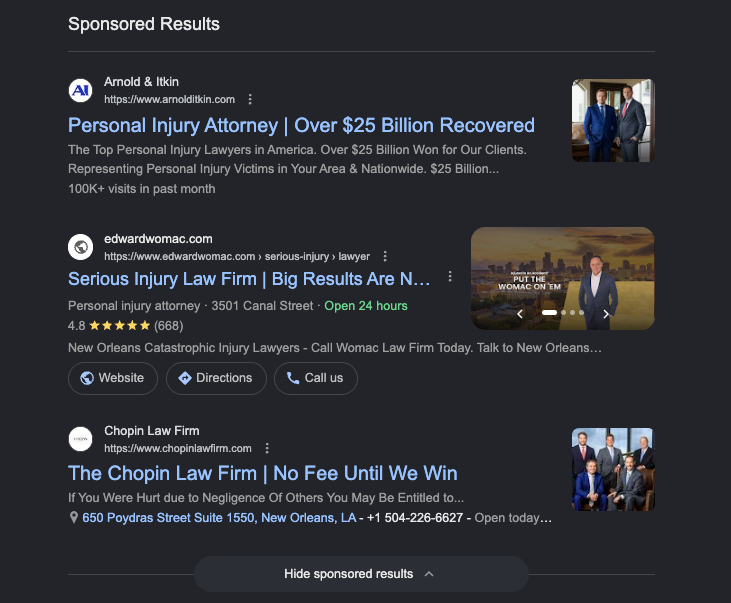
Google Ads gives you targeting precision and campaign control.
- Keyword match types (broad, phrase, and exact) control which searches trigger your ads.
- Ad copy and landing page routing stay fully in your hands.
- Bid strategy can be tuned toward specific conversion events.
This is the stronger tool when a firm needs to isolate a practice area, operate across competitive geographies, or tightly control messaging. Firms building this out often start with structured PPC management services before piecing campaigns together ad hoc.

Local Services Ads bring trust signals and pay-per-lead pricing. LSAs display the Google Screened verification badge, which traditional search ads cannot show. Trust is the biggest hurdle in legal, and that badge helps clear it. You pay for each verified lead, which changes the budget math considerably.
| Google Ads | Local Services Ads | |
| Pricing | Per click | Per verified lead |
| Trust signal | Standard search ad | Google Screened badge |
| Best for | Practice-area targeting and message control | Local, high-trust searches |
| Control | Full keyword and landing-page control | Largely Google-managed |
The two are distinct systems that may work together depending on your market. Firms should try both and see how well they work in order to determine the right mix.
For example, a personal injury firm covering one metro runs Local Services Ads to capture broad, high-trust searches like ‘injury lawyer near me,’ where the Google Screened badge does the persuading and billing is per verified lead. Alongside it, a Google Ads campaign bids on exact-match terms like ‘motorcycle accident attorney,’ each routed to a landing page built for that specific case type. The LSA wins the local, trust-driven click. The Google Ads campaign controls the message and page for the higher-value, more specific case. It is one firm and one budget doing two different jobs.
How to structure a profitable law firm paid search campaign
A profitable campaign is mostly won before it ever goes live. The firms that get a return decide the structure first and let the spend follow, because that is what turns expensive clicks into signed cases. Most of it comes down to four decisions.
Start with who you’re bidding against
Before you set a single bid, know who you are bidding against and what they already rank and pay for. Look at which firms hold the top positions in your market and practice area, which keywords they defend, and where their coverage is thin. That picture shows where you can realistically win. Build the campaign around that read instead of a generic keyword dump.
Segment campaigns by practice area
A personal injury campaign and an estate planning campaign have almost nothing in common. They differ in intent, case values, competitors, and acceptable cost per case. Run them in one bucket and one area’s performance hides another’s waste. Split campaigns by practice area so budget, bids, and messaging can be tuned to each. Then reporting shows which areas actually pay.
Match ad copy and landing pages to the search
The click is only worth what the page does with it. Send a ‘motorcycle accident lawyer’ click to a generic homepage and you have paid a premium for a bounce. Each campaign should route to a page that speaks to that exact search, with the offer, proof, and next step aligned to what the prospect typed. Misalignment between ad, keyword, and page is the most common reason high click volume produces low consultation rates.
Build tracking in before you spend
Decide how you will measure a signed case before the campaign goes live. That means call tracking tied to campaigns, form-fill confirmation, and a path for intake outcomes to feed back into reporting. Without that wiring in place from the start, you can spend thousands without knowing which keywords produced clients. Measurement gets its own section next, but the plumbing has to go in here, before the first dollar goes out.
How to measure paid search from click to retained client
This is where most of the 82% dissatisfaction problem gets resolved. There are three measurement layers, and most firms only have the first.
Layer 1, click-to-lead tracking. Nearly every firm running Google Ads has this baseline. Think call-tracking numbers tied to campaigns, form-fill confirmations, and sometimes call recordings. It shows the cost per lead and which campaigns drive volume. What it can’t tell you is whether those leads became consultations, whether those consultations produced retained clients, or whether one practice-area keyword pulls better-qualified prospects than another. Most firms recognize this as their current state and mistake it for the whole picture.
Layer 2, lead-to-intake tracking. This connects calls and form fills to consultations, which requires coordination between your marketing reporting and the team that handles intake. Here, a firm can spot that a campaign generates high call volume but low consultation rates, a signal that ad-to-landing-page alignment or keyword intent is off. Pareto Legal’s 2026 study, which tracked $3.3 million in managed ad spend, puts cost per signed case at $192 for bankruptcy, $468 for personal injury, and $659 for criminal defense. Most firms can’t calculate their own number because they stop at Layer 1.
Layer 3, intake-to-retained-client tracking. The layer most firms lack. It requires intake outcomes to feed back into marketing reporting, whether through CRM integration or structured intake logging, so a firm can see which campaigns, keywords, and ad copy actually produced signed clients. Without it, budget decisions rest on lead volume rather than case quality. FirmPilot ties campaign spend to the leads each campaign produces, and its real-time dashboards show law firm marketing teams which sources and keywords drive that volume. Full signed-case attribution requires CRM integration, so it becomes available only once that is configured.
Response speed sits underneath all of this. Leads contacted within five minutes close at 32%, more than double the 12% rate for leads reached a day or more later, per a 2026 analysis of 939 companies. Paid search reporting can surface which campaigns produce the fastest-responding leads, but only if the intake layer is tracking outcomes in the first place. FirmPilot’s AI-driven PPC management connects campaign performance to that lead visibility.
What Google’s AI Max means for law firm campaigns
AI Max hands more control to Google’s automation. Generally available since April 2026 after opening in beta in May 2025, it introduces query expansion (ads serve on searches beyond your keyword list), dynamic ad copy generation (Google writes headlines and descriptions automatically), and Final URL expansion (Google routes traffic to pages it decides are relevant, which may not be your optimized landing page).
Justia Onward’s November 2025 analysis breaks down some risks specific to legal:
- Low-intent query matching can serve your ads on searches like “free legal advice” or “DIY lawsuit forms,” draining your budget without producing qualified leads.
- Auto-generated copy can produce headlines that conflict with bar advertising rules, especially around contingency-fee language, superlatives, and outcome claims.
- URL expansion can route clicks away from your conversion-optimized landing pages.
The answer is discipline. Negative keyword management, brand exclusion controls, and conversion-tracking depth all matter even more once AI Max is running. A firm that hasn’t invested in attribution is more exposed to targeting drift because it can’t even detect the problem. Landing pages compound the problem. Personal injury firm sites convert at 2.8% on average, while top performers reach 18%. FirmPilot’s AI-driven optimization uses legal-specific conversion signals to maintain targeting discipline under Google’s automation.
How FirmPilot approaches law firm paid search
Competitive intelligence that builds winning campaigns from the start. FirmPilot begins where most law firm campaigns should, with a clear read on the market you are bidding into. Its AI maps which firms hold the top positions in your practice area, what they bid on, and where their coverage is thin, then builds campaign structure around those openings. Keyword research and targeting run on legal-specific conversion data rather than generic signals, so the campaign is engineered to win the searches that produce cases.
Reporting that ties spend to the leads it produces. FirmPilot’s real-time dashboards show law firm marketing teams where leads originate, which campaigns and keywords drive them, and where budget is producing clicks that never become leads. When CRM integration is configured, that reporting extends to signed-case tracking. Signed-case attribution depends on that connection and is not available by default.
Practice-area campaign architecture. FirmPilot structures paid search by practice area rather than as generic legal campaigns, using competitive intelligence on how similar firms in the same market bid. A personal injury firm in a competitive metro needs a structurally different approach than a family law or estate planning practice, which is where measuring marketing ROI by practice area earns its keep. Book a demo to see how your current campaigns are performing.
Book a demo, and we will walk your firm through current campaign performance and the competition you’re bidding against.
Frequently Asked Questions About Law Firm Paid Search
What is a realistic cost per click for law firm paid search? LocaliQ/WordStream’s 2026 benchmark puts Attorneys and Legal Services at an average of $9.87, versus $5.42 cross-industry. High-competition areas like personal injury, mass tort, and criminal defense in major metros regularly run $50 to $300 or more. The real question is whether that CPC is sustainable given your case values.
What is the difference between Google Ads and Local Services Ads for lawyers? Google Ads gives you keyword-level targeting control and per-click billing. LSAs offer the Google Screened verification badge and pay-per-lead pricing. They complement each other, and most firms benefit from running both.
How should law firms measure paid search ROI? Track three layers, from click-to-lead to lead-to-intake to intake-to-retained-client. Firms that stop at cost per lead can’t tell which campaigns produce qualified cases. FirmPilot’s competitive intelligence shows law firm teams where spend is producing leads and what comparable firms are bidding on the same keywords and campaigns.
What are the risks of Google’s AI Max for law firm campaigns? Justia Onward names three. Low-intent query expansion, auto-generated copy that can conflict with bar rules, and URL expansion that bypasses your optimized landing pages. The mitigation is configuration discipline, which means negative keywords, brand controls, and deep conversion tracking.